Sketching the Street: Five Mini Experiments to Train Urban Memory
Long before smartphones and GPS, travelers, surveyors, and writers developed habits to remember streets, corners, and small details. The 19th-century flâneur walked to learn a city’s rhythm; early mapmakers condensed a neighborhood into a few careful lines. Today those traditions survive in urban sketching clubs and the simple notebooks people tuck into their pockets. The skill beneath these practices is not artistry but a reliable, portable urban memory: the ability to notice, record, and recall a stretch of street.
How these experiments work
Each of the five experiments below is short—two to ten minutes—and designed to be done in sequence on a single block or intersection. They build on one another: counting and naming details prepares you for sketching; the sound map widens attention to layers you might otherwise ignore; material tagging trains classification; the memory return combines everything into a compact mental map. Do them solo, or invite a friend and compare notes afterward.
Experiment 1 — The Five-Minute Block Inventory
Purpose: train focused visual scanning and categorical noticing.
- Stand at one corner of the block. Set a five-minute timer.
- List aloud or write five categories: doorways, storefront signs, trees, street furniture (benches, bike racks), and colors.
- Walk the block slowly once, counting and noting each item in those categories. Keep descriptions to one or two words (“red awning,” “oak tree,” “blue metal bench”).
- When the timer ends, stop and glance back across the block; add any late observations.
Experiment 2 — The One-Minute Thumbnail
Purpose: translate observation into a compact visual record without worrying about drawing skill.
- Sit on a stoop or bench. Set a one-minute timer.
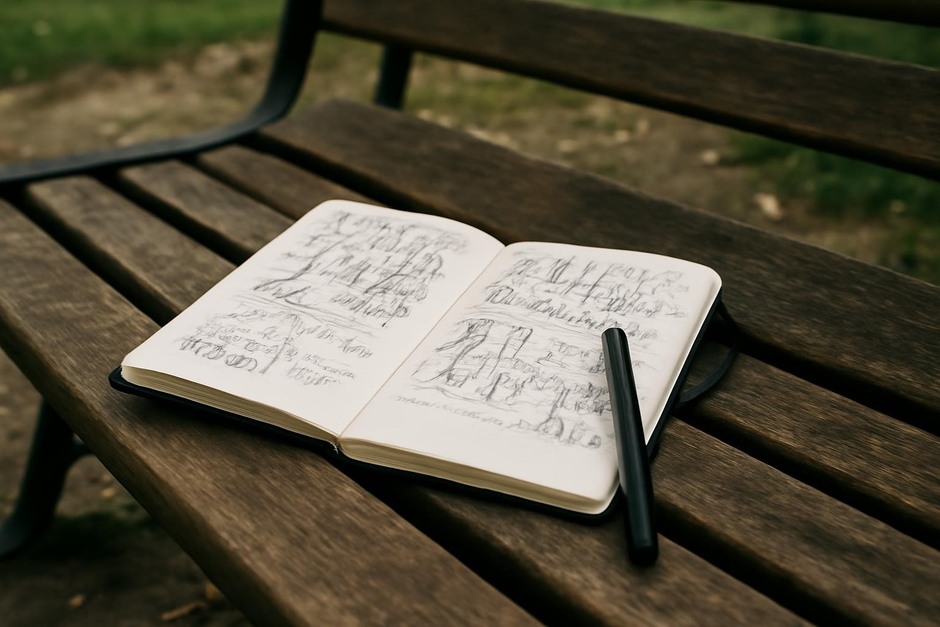
- With a pen and small notebook, make a single thumbnail sketch of the corner you can see. Use simple shapes and a few marks to indicate the largest elements: building masses, a tree’s shape, a sign, a parked car.
- Label only the most distinctive element with a single word (“bakery,” “corner stoop”).
Experiment 3 — The Two-Minute Sound Map
Purpose: add auditory layers to your mental map so memory isn’t only visual.
- Stand in the middle of the block or crosswalk. Set a two-minute timer.
- Facing whatever direction feels most natural, draw a simple circle on your page representing your position. Mark the direction of sounds with short lines and a word: “jackhammer (SE),” “children (park, W),” “music (café, N).”
- Note the intensity and quality—distant, near, intermittent—so sounds can later serve as anchors in recall.
Experiment 4 — Material Tagging (Three to Five Minutes)
Purpose: learn to classify surfaces and textures so places become tactile in memory.
- Choose three building facades or stretches of sidewalk. Spend one minute at each.
- Write quick tags for materials and details: “red brick, ivy, rusted fire escape,” “polished marble, brass door handle,” “cracked concrete, weed in joint.”
- Make a one-word note about feel: “rough,” “smooth,” “cold.” These tactile cues anchor visual memory.
Experiment 5 — The Memory Return (Five Minutes)
Purpose: combine earlier observations into a small, usable mental map.
- Walk away from the block for three to five minutes—find a bench, cross the street, or step into a café.
- Without looking back at your notes, spend five minutes drawing a compact map of the block from memory. Place your position, two landmarks, one sound source, and one material cue.
- Return to the block and compare your map to reality and to your earlier notes. Note one pattern you missed and one detail you remembered particularly well.
Practical notes and next steps
Tools: a pocket notebook (3.5 x 5 in. is comfortable), a pen, and a timer on your phone are all you need. Keep entries small: a spread for each block, with the thumbnail, a few tags, and a short memory map. Repeat the sequence on different blocks—start with a familiar street, then try a route you walk less often.
If you continue this practice, you’ll notice two things: first, your ability to encode a place quickly improves; second, you begin to compose portable, personal maps—mental shortcuts for routes, meetings, or photographic opportunities. The practice is not about producing perfect sketches but about training attention to the textures, sounds, and shapes that make a city legible.
Over weeks, these small experiments become a quiet archive of places you’ve practiced. They are useful for writers, photographers, neighbors, and anyone who wants to remember a city with more than direction—remembered instead as a collage of sensory cues and small stories.